Protect This Hims House
In preparation for my appearance on the Hims House pod, I offer some thoughts on the company

The Corrections
Follow me on X: @TheRealBirnbaum
Email me: themarket.psychoanalyst@gmail.com
TABLE OF CONTENTS
Guess Who’s Gonna Be on Hims House
The Thesis
Finally Getting My Flowers
Next Time
“Invert. Always invert.”
-Charlie Munger
Guess Who’s Gonna Be on Hims House
I’ve been invited to join the amazing Hims House podcast. We’ll be recording in a couple of weeks with the focus on earnings. Expect the episode to drop shortly thereafter.
It seems fitting that I do a mini dive into Hims & Hers ($HIMS) in preparation for the episode. As always, we’ll address the subject from the perspective of optimizing our psychological and therefore behavioral posture.
The issue with companies like Hims rests with the market’s tendency to extrapolate the next 12 months out into eternity. This hurts early-stage growth companies with lumpy growth due to aspiring for more than just a maximization of the next quarter. Duolingo ($DUOL), as we saw with today’s earnings, suffers the same dynamic.
In reality, at the helm of these businesses stand two of the world’s best founder-CEOs. They’re making deliberate decisions that temper current financials to optimize future and terminal value. The market has never and will never be able to reward investment without perceived total certainty of the return on investment.
Why? Because it’s made up of humans. And most humans are irredeemably stupid. It doesn’t mean they’ll be wrong about Hims, or that I’ll be right. But if I build a portfolio of enough businesses with a world-class founding culture, talent, and model, I need only a handful to be winners to dominate the market.
Thus far, I’ve been right more often than I’ve been wrong.
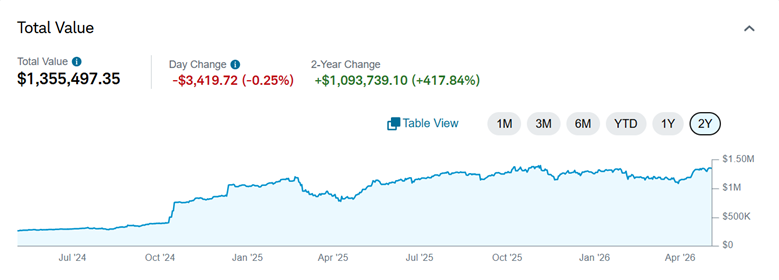
The Bears Can Smell the Menstruation
Hims & Hers is one of the most polarizing companies in the market. Perhaps more than any other stock, the bears really rear up, puff out their chest, and give off a guttural growl whenever confronted with the threat that Hims might just be a valuable business.
But it goes deeper than valuation. Hims attracts bears like a littered camping ground at night.
Sometimes the best way to reach the truth is to take the back door.
Blue Chip or Bust
Many of the bears go so far as to claim that Hims is unethical and even harmful to patients. They cite patterns of cursory prescribing, contaminated compounds, and other cherry-picked and exaggerated claims.
Meanwhile, founder and CEO, Andrew Dudum, has claimed on countless occasions—including his respective appearance on Hims House—that Hims plays strictly by the rules—that they’re the bluest of the blue chip.
Like with most things, the reality is somewhere between the two claims. But, with infinite points along any line, the question is how far Hims sits toward either end of the spectrum.
Let’s start with some facts:
Reported adverse events occur with all medications. No evidence exists that patients have been harmed due to prescriber negligence or compounding toxicity.
No contaminants or toxicities have been discovered in Hims products.
Hims Net Promoter Score (NPS) consistently hovers in the high 60s—a very strong rating indicating consumer satisfaction and willingness to repeat purchases. Typically, when customers are rolled or harmed by a business, they move on rather than expose themselves to their repeated detriment.
It’s safe to say that these claims hold little if any merit.
Other Hims bears, like the world’s angriest doctor, Adam May, tend toward an alternative tack: that, for example, the entire concept of personalization lacks any efficacy whatsoever.

I find it difficult to reconcile how a man with the intellectual firepower to conquer med school and leverage that degree to make millions in the market on healthcare stocks can fall prey to such a moronic notion. Then again, the guys at Long Term Capital Management stand as an everlasting reminder that really smart people can persist in really stupid ideas for very long stretches of time. Only when they’re physically forced to reckon with the absurdity of their conceit does reality pierce the thick armor that is a Brilliant Man’s ego. Not that I’m suggesting Adam May is brilliant—I hardly know the guy—but he’s clearly got some game on the tape, yet he was convinced Hims would be sued back to the stone age.
Anyway, the point is that personalization is not only obviously efficacious, but it’s also the future of medicine. It doesn’t take a healthcare equities wunderkind to understand that two people react differently—sometimes dramatically so—to the same treatment. If you agree with this fact, it’s impossible to deny the potential for personalized medicine.
The future of personalization pushes light years beyond individually titrated doses of tirzepatide. The future includes a costless and complete map of one’s proteome that allows for preventative treatments of faulty genetic code.
Lookgate
Another incoherent roar emitted from the clumsy maws of the bears can be summed up by a single post on X. Not just a single post, but a single character—an emoji—posted in response to the infamous Antonio Linares.
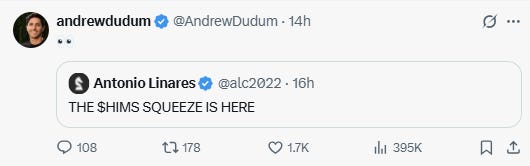
Dudum’s cogent reply seemed to perfectly encapsulate what bears had been growling about for ages: that Andrew Dudum is just the latest of history’s endless procession of snake oil salesmen.
Bears tend to cite the constant and enormous sale of stock by Dudum and other insiders. They then came to the natural conclusion that the above reply suggested that Dudum was pumping the stock to increase his profit from the next sale of shares.


One of the problems with this theory is that Dudum’s sales—along with the rest of insiders’—are prescheduled. They occur without any influence from the stock price’s unparalleled gyrations.
The other larger and more glaring problem is the epic hypocrisy. Many bears are the same lumbering homunculi who represent the first to defend the antics of Elon Musk and Alex Karp, which dwarf a set of cartoon fucking bugeyes. The amount of attention and criticism received put on full display not only the bias, but also, in my humble opinion, the fear that resides within each bear’s heart.
Or, maybe what we witnessed in this incident was merely another instance of X’s herd function. Perhaps it was more akin to any viral subject matter, like when you see a parade of posts about the dangers of investing in the S&P 500 at ATHs—completely lacking in any factual merit, but great for engagement.
The Bearmasters
Novogate
Bears pounded the table for over a year before their predicted lawsuit came to pass. Put simply, to the bears, it was inconceivable that Novo Nordisk ($NVO) would allow Hims to compound and distribute their most profitable drug, semaglutide—better known as Ozempic—long before its patent protection is set to expire.
The only reason a lawsuit came to pass was due to Andrew Dudum forcing the issue. Hims announced the pill formulation Novo had just released under patent protection, without any shortage sanction or justifiable path to 503A loopholes. Finally, in early February, Novo struck. Hims would be cutting deep behind enemy lines, far too close to the mothership for comfort. So Novo delivered notice of their lawsuit.

But the Novo lawsuit was only the beginning. The pill announcement was so egregious, it triggered lawsuit from the FDA as well, and an investigation by the DOJ.
The stock plummeted, the bears celebrated, and the pundits called for Hims’ head. Few maintained the equanimity and foresight to understand that Dudum hadn’t been struck dumb the previous day. He had a plan. Announcing the pill was just another move amid a marathon chess match.
Dudum accelerated the timeline. The compounding drama threatened to drag on for months, if not years. The pill forced an action which he saw as inevitable to occur at his convenience. Just weeks after this apparent catastrophe, while even noted Hims bulls were losing the faith, Hims announced a partnership with Novo that drew an immediate and total end to the confrontations on all fronts.
To call this series of events improbable would be an understatement. But that’s exactly what the best CEOs and their companies do, over and over and over and over. They execute what seems like an impossible series of wins in a way that renders all but impossible any possibility that it’s just luck.
So then why do the bears persist? Why do they continue to proclaim Hims a shitco after every one of these essentially impossible feats?
The Big Short
The manifestation of all bear theory rests in a single metric: 34% short interest (depending on the source, it’s as high as 35%). Short interest in the past has shot beyond 40%.
I’ve never seen short interest this high in profitable a company with a topline growing 59% YoY and execution that harkens back to the early days of Amazon. No other company in Hims’ corner of the industry has vertically integrated and brought products to market as fast or as profitably. The shorting makes no sense.
I’ve remained open to conspiracies given the seemingly endless onslaught of hit pieces in mainstream outlets such as Barron’s or The Wall Street Journal. The headlines tell you everything you need to know:
Hims & Hers Is Offering a New Cancer Test. It May Not Be Ready for Prime Time.
Hims & Hers Stock Plunges 16%. Its Weight-Loss Drug Strategy Backfired.
Hims & Hers Is in the FDA’s Crosshairs. It’s a Risk to the Stock.
Hims & Hers Stock Is Due for a Crash Diet. The Weight-Loss Drug Surge Is Fading Fast.
They Wanted a Quick Fix for Hair Loss. Instead, These Young Men Got Sick.
A Quick Fix for Hair Loss Is Making Some Men Sick.
How Ozempic Brought a Napster Moment to Big Pharma
Try to find a bullish piece on Hims & Hers. I dare you. The best you’ll scare up is neutral reporting of the facts.
Which brings me to my point: while no grand conspiracy exists to put Hims into the guillotine, to deny that powerful forces are ranked against Hims is, to me, an exercise in a more pathological form of denial.
The best analogy to Hims is Amazon, which we’ll expand upon here in a bit. Once Amazon began to prove the efficacy of their model, brick-and-mortar retail tried to stand up their own online stores en masse. By then it was too late. Amazon had won.
Similarly, we see the big pharma players like Eli Lily (LillyDirect) are building their own digital platforms that allow them to own a bigger share of the supply chain.
Barnes & Noble tried to compete with Amazon. The problem? They sold only new books. Both words in this phrase are key. Amazon not only sold old books—more and more those days, they were beginning to sell everything
The problem—as it was for Barnes & Noble, along with every other brick-and-mortar store selling specific goods—is that Lilly can only build a platform that sells Lilly-branded drugs. They can’t sell Novo drugs. That would be bad for business. They can’t sell generic drugs directly. That would be even worse for business.
It goes further than what big pharma can sell. It’s also what they can’t sell, which is prevention of disease, illness, and injury in the first place. Unless they generated preventative treatment that compensated for revenues lost in palliative treatment, this would disrupt their entire business model.
Only an independent, unconflicted entity without a financial dogma can provide what the public needs. And therein lies the thesis for Hims.
The Thesis
The analogy to Amazon runs deeper than competitive dynamics. It cuts to the core of Hims’ mission and model.
Amazon started with books. Hims started with sexual health.
Amazon added new products only after succeeding with the previous product. Hims is adding new verticals almost one-by-one, unless a pair or set of new products are bundled together.
The ecommerce companies that attempted to do it all at once failed (Webvan). The digital health companies suffered the same fate (Teledoc).
Amazon was obsessed not with the competition, but the customer. While Hims bulls and bears complain about the lack of partnerships with Novo or Lilly, Dudum remains concentrated on the patient.
Amazon outsourced only enough to scale, eventually building its own internal UPS. Hims is the only vertically integrated digital health platform.
Amazon’s ambitions infinitely exceeded analysts’ concept of the company in its early years, with the Street obsessed with book sales and publishing news. Hims’ ambitions extend far beyond sexual health, dermatology, and GLP-1s, the latter of which analysts and investors remain obsessed with. Next they will obsess over peptides (as retail already has). It will always be something, until it’s everything.
The above ambitions may turn out to overlap more than one might think. Amazon went covert on AWS in the 2000s, and I believe Hims is building a platform we will be able to fully comprehend only in retrospect. Amazon invented the cloud. Hims may very well invent a healthcare operating system heretofore unimagined.
The latter point puts an exclamation on the thesis, which contains many layers.
I’m invested in Hims for the potential 10 million subscribers, $650 per sub in revenue, and $1.3B in EBITDA that Dudum has projected for 2030. (Given that current revenue per sub is a hair under $1,000, Dudum is either sandbagging, or he thinks revenue per sub will decline due to a mix shift.) In this scenario Hims is likely a $20B business with the potential to continue compounding from there.
But I’m also invested in Hims for the possibility that Hims becomes a vertically integrated digital healthcare operating system. In this case, Hims is a $1T business. Such reasoning drives Antonio’s $2,000 per share projection for 2030.
The latter element of the thesis, while far less likely from a statistical standpoint, becomes more realistic if you believe Dudum stands on a podium with Bezos. Thus far, such a comparison remains plausible.
Dudum has not shied away from shaking things up to drive the company toward his vision. He’s rejiggered his team, dropped the pill bomb, and started pouring cash flow back into the business. Their AI hires, specifically the parade of former Cruise (General Motors) team members, hint at the bigger ambitions lurking in the background. The overseas acquisitions (namely Zava and Eucalyptus) suggest Dudum sees an opportunity that extends far beyond the more obvious problems with American healthcare.
These ambitions work to mitigate my biggest concern at present: that Hims has allowed Roman, also known as just Ro, to catch up with them in the U.S. Looking beyond the present requires the deployment of resources—investment of time, money, and energy—that have to come from somewhere else. Every customer of Ro’s is not only a lost paying subscriber but also lost data. Striking the right balance requires insight that I simply don’t have, and therefore I choose to delegate to Dudum, which thus far has proven lucrative.
Hims may be a public company. But Dudum founded the business just eight or nine years ago. Hims came public just four years after opening its digital doors. For comparison, Palantir didn’t come public for something like two decades. Hims is in many ways a venture-backed business that happens to be publicly-traded.
This requires a psychological approach that differs in many ways from that of my other holdings. In addition to Amazon, another great analogy for Hims lies with Uber. Just as Uber had its scrapes with the cab companies and warred with states, municipalities, and their representatives, Hims too has found itself battling industry incumbents, lunging over regulatory hurdles, and jockeying for favor with federal bodies.
I fully expect more volatility in these areas and therefore the stock price as well. Understanding this allows me to hold through these peaks and troughs. Though I often monetize volatility by writing options contracts, and I limited my tax burden by selling shares in December and buying back after a month, these are unnecessary moves that risk interrupting the compounding process. On the other hand, they also help me stay in the stock, so striking a balance has been optimal.
One of my biggest suggestions as a shareholder of Hims & Hers—and this can be applied to any company, but is particularly important here—don’t obsess over short-term financial metrics. Yes, Hims bears similarities to Amazon, Uber, and even Spotify in the sense that big tech (such as Amazon, coincidentally) is dying to take share. But I expect the numbers to resemble Spotify’s far more than the former two. The Street doesn’t appreciate the lumpiness and an opaque if not outright furtive business model.
More than anything, shareholders must block out the noise of quarterly earnings volatility, shuffling of the org chart, and criticisms of Dudum’s every move, down to emoji replies to FinX retail investors.
Finally Getting My Flowers
Those of you who follow me on X know I’ve been pounding the table on Blue Owl, both the parent company (Blue Owl Capital Inc., ticker $OWL) and public business development company (Blue Owl Capital Corp, ticker $OBDC). Well, they reported earnings last week, and wouldn’t you know it, they were completely fine.
You read that right. Rarely does one brag about a company they own delivering satisfactory earnings. Take Alphabet, for instance, which reported a barnburner last week. Amazon too, if you ask me.
Blue Owl on the other hand? Fine. Not great, not terrible. Just fine. But that’s all they needed for the parent to shoot up 10%.
Why? Well for one they reported a 10X return on their investment in SpaceX. Blue Owl locked in profits on half the position this past quarter.

But more importantly, shares popped because the market has priced in total disaster. Blue Owl Inc. shares are down 60% from their peak and were down more than 70% at the bottom. At these levels I calculated the market was pricing in at least a 20% decline in AUM and 10% rise in defaults. I’ve never seen stock prices fall in anticipation of something that not only hasn’t happened, but is very unlikely to happen, quite like the past few months.
What happened last quarter silenced that narrative—for the time being, at least. If you take anything from my Substack, it’s that narratives drive markets over the short term, but FCF does the long term. And narratives are quite often dead wrong.
For Blue Owl it’s been a double-whammy. Fears of software disruption led to fears that private credit’s loans to software businesses were fucked, I believe is the technical term. Such fears fomented more headlines about a spike in redemptions and requests for redemptions than actual redemptions and requests for redemptions. Even investing greats like Steve Eisman have succumbed to the headlines.
And maybe he’ll turn out to be correct. This story is far from over as AI continues to progress at full speed and the economy remains stuck in the purgatory of Hormuz. Eisman’s theory, now that earnings gave little sign of trouble, now takes the view that the decline in software equity marks will make it tough if not impossible for private lenders to refinance their loans. He cited the collapse in shares of ServiceNow as a leading indicator of things to come.
I call bullshit. First, private equity marks are far less volatile than public equities. Without tangible business declines, we won’t see nearly the same level of declines as we’ve seen in public software names. Thus the share price of ServiceNow has little if any bearing on private software valuations. Yes, Ares has had issues in one of its funds. But Apollo recently did a review of their PC portfolio and found that 85% of loans were exceeding expectations, 14% were in fine shape, and 1% were troubled. Eisman used ServiceNow as a means to invalidate Apollo’s review, but earnings results are proving him wrong in real time.
The good news is that my Blue Owl shares are up across the board. Better yet, I’m finally getting my flowers.

I may not know who the fuck this is, and there’s little to celebrate with my shares still down roughly 25% overall, but I’ll take it anyway.
There’s a lot more to this bet that I won’t go into right now. Over time, we’ll dig in deeper as the story continue to play out.
Next Time
Now that the market is back to ATHs, the bubble boys are back on tour. The piercing, screeching, whine of the permabears, market-timers, and traders over-allocated to cash has risen to a level only dogs can hear faster than ever before.
I spent much of my first few posts empirically lambasting these fools. I thought they’d moved on after the break in growth stocks from October to March. But they’re back in full force, louder than last year. The 28% YoY earnings growth in the S&P apparently doesn’t justify a significant move higher—I’ll stop myself here, before I get going.